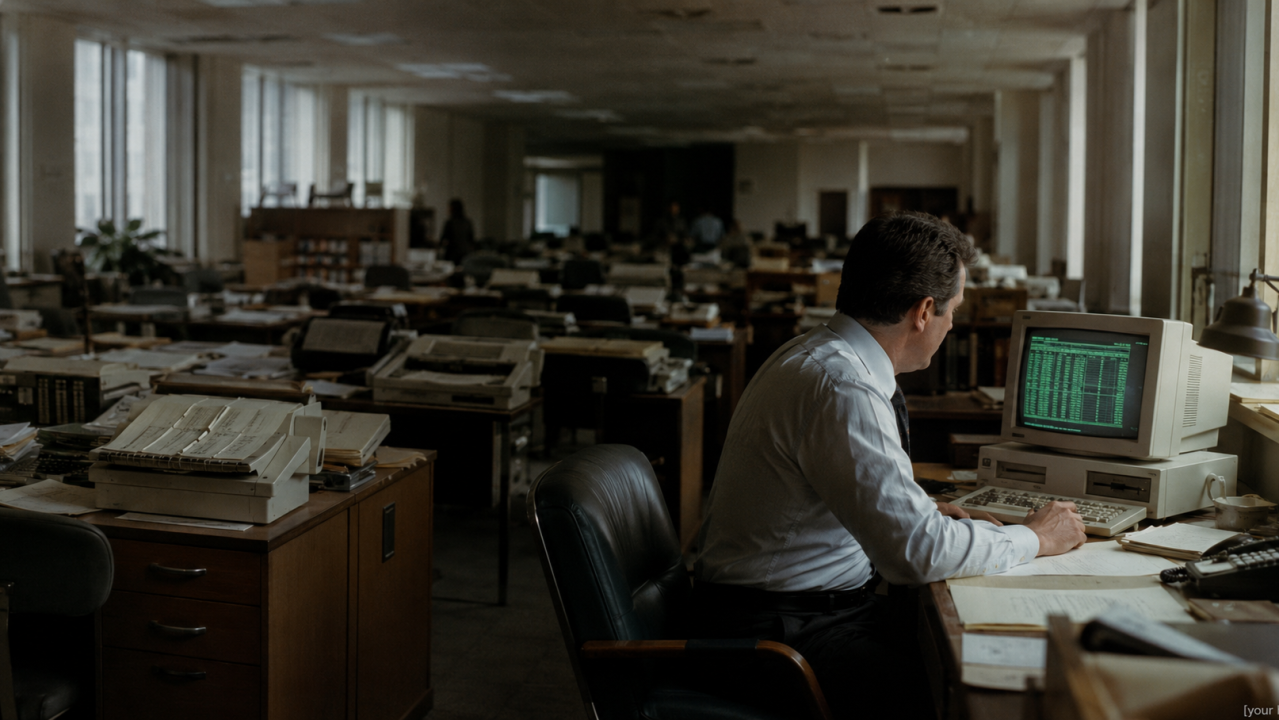
There's a meme doing the rounds an old Nokia 3310 with a text conversation on the screen. A friend says "I think Claude can replace developers." The reply: "Sure. Right after Excel replaces accountants."
I've seen it shared a dozen times, always with the same energy: relax, everyone, we're fine. And every time I want to reply: have you actually looked at what Excel did to accountants? Because the analogy is a much better one than the people sharing it seem to think. It's just not comforting.
What actually happened when the spreadsheet arrived
VisiCalc shipped in 1979. Lotus 1-2-3 and then Excel followed. And here's the number that matters, courtesy of the US Bureau of Labor Statistics via NPR's Planet Money: since 1980, around 400,000 bookkeeping and accounting clerk jobs disappeared in the US. Over the same period, roughly 600,000 accountant jobs were added.
Read that again. The spreadsheet didn't replace accountants. It replaced an entire layer underneath accountants the people whose job was the mechanical part of the work. Running the ledger. Re-footing the columns. Recalculating a forty-page model by hand because one assumption changed, which used to take a room full of people the better part of a week and now takes a keystroke.
Those jobs didn't evolve. They ended.
Meanwhile the accountants the people whose job was judgment, not arithmetic did better than ever. Once running the numbers became nearly free, clients wanted far more numbers run. What happens if we open the second factory? What if interest rates move? Model it five ways. Accounting got cheaper, so the world bought vastly more of it. That's why the profession grew while the clerks vanished.
So the meme is accurate. Excel never did replace accountants. It did something more surgical: it split the profession in two, kept the half that thinks, and deleted the half that types.
The uncomfortable question for developers
Now run the analogy forward properly.
"Developer" is not one job. It never has been. Part of what I do is judgment: deciding what to build, what "correct" means for this business, which corner of the system will hurt us in two years, when to say no. And part of it if I'm honest about my last twenty-plus years has been mechanical translation: taking a decision that's already been made and turning it into working code. Boilerplate. Glue. The fourth CRUD screen. The integration that's just like the last integration.
That second layer is our bookkeeping. And that's the layer the models are eating, fast.
So the question the meme should raise isn't "will Claude replace developers?" That framing lets everyone off the hook, because the answer is obviously no, in the same way Excel obviously didn't replace accountants. The real question is the one the clerks never got to ask: which half of your job are you?
If most of your value is that you can reliably turn a clear spec into working code, you should be paying very close attention right now. Not because you'll be replaced by an AI, but because you'll be replaced by the same thing that replaced the clerks: a professional one layer up, holding a tool that makes your layer nearly free.
If most of your value is judgment architecture, trade-offs, knowing what not to build, being the person who can tell when the plausible-looking output is wrong then the accountant half of the analogy applies to you, and it's good news. Software just got dramatically cheaper to produce. And when something gets cheaper, the world doesn't buy the same amount and pocket the savings. It buys more. Far more. Every business that could never justify custom software is about to be able to. Somebody with judgment has to stand between all of that demand and all of this new capacity.
The part nobody puts in the meme
Here's what I keep coming back to, and it's less pleasant than the meme wants to be: the clerks were good at their jobs. They weren't lazy or stupid or behind the times. Their skill was real. It just stopped being scarce, and scarcity was the only thing their salary was built on.
Some of them became accountants. Many didn't. The transition was real for the profession and brutal for a lot of the individuals in it, and it happened over a decade or so slow enough that on any given Tuesday you could tell yourself things were fine.
I've been writing software for more than two decades, and I still ship code most weeks these days with AI in the loop, doing more of the typing than I'd have believed possible three years ago. The typing was never the part I was paid for, though it took me embarrassingly long in my career to understand that. The people who figured it out early in the spreadsheet era didn't fight the tool or dismiss it with a meme. They looked at their own week, worked out honestly which hours were clerk hours and which were accountant hours, and moved their weight onto the second kind before the market forced the issue.
The meme is right. Claude won't replace developers, just like Excel didn't replace accountants.
Ask a bookkeeping clerk from 1985 how much comfort that distinction turned out to be worth.
Originally published on LinkedIn.