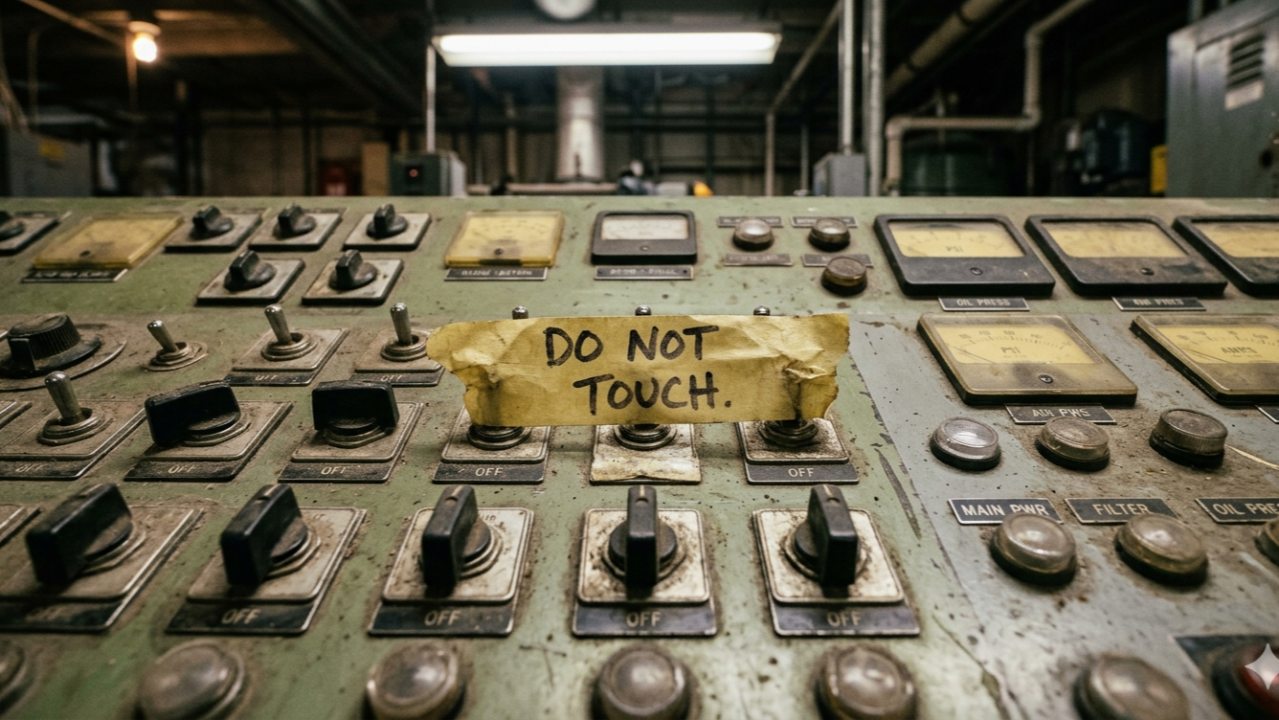
I've been in software long enough to hear that phrase in almost every organisation I've worked with. It's said with confidence, usually by someone who's been around long enough that people don't push back.
For years I let it pass. Pragmatism, right? Pick your battles.
I don't buy it anymore.
The phrase isn't wisdom. It's a diagnostic.
What someone means when they say "if it ain't broke, don't fix it" tells you a lot about where they actually are.
A senior engineer who genuinely understands the system and has consciously decided the cost of change outweighs the benefit — that's legitimate. They can explain the risk, the blast radius, the opportunity cost. They've made a reasoned trade-off and could defend it in front of anyone.
That's not usually who's saying it.
More often it comes from someone who can no longer confidently reason about the system. Who doesn't know what will break if they touch it. Who has learned, through pain or observation, that this area is a minefield — and the safest move is to route around it.
That's not pragmatism. That's accumulated fear presented as experience.
The two kinds of lazy developer
There's a version of laziness in development that's a sign of mastery. The developer who writes ten lines where someone else would write a hundred. Who sees the elegant path because they understand the problem well enough to simplify it. Who instinctively asks "is there a version of this that doesn't need solving at all?"
That kind of lazy is earned, and it's rare.
Then there's the other kind. The developer who doesn't touch something because looking too hard at it feels dangerous. Who defers, deflects, and routes around problems instead of through them. Whose code works, technically, but whose system has quietly become a body of knowledge that only lives in the heads of people who've been around long enough — and slowly leaks out every time one of them leaves.
"If it ain't broke" is almost always spoken by the second kind.
What AI actually changes here
For a long time, avoidance was at least economically defensible. Questioning a process, mapping its dependencies, challenging its assumptions, modelling an alternative — that took real time and real organisational energy. The friction of examination was genuine.
That cost has largely collapsed.
With AI, you can audit a system, surface hidden dependencies, challenge assumptions, and sketch alternatives in a fraction of the time it used to take. The barrier to asking "should this work differently?" has dropped dramatically.
Which means "we don't have bandwidth to rethink this" has stopped being a real constraint. For most organisations, it was already more excuse than reason. Now it's almost impossible to sustain.
What I don't think gets said enough: AI isn't just automating tasks — it's removing the economic justification for avoidance. Every process running on inertia, on tribal knowledge, on the implicit agreement that questioning it is too expensive — AI is going to put pressure on all of it. Fast.
The question worth asking
I ask every client some version of this before we start any modernisation work:
Which parts of your operation are stable because you've made a conscious, deliberate choice to keep them that way — and which are stable because the cost of looking at them always felt too high?
Most can answer the first part quickly. The second takes longer. Sometimes much longer.
That's where the real work is. Not in picking AI tools. Not in running pilots. In being honest about which parts of your organisation have been coasting on the assumption that examination was too expensive.
Because it isn't anymore.
"If it ain't broke, don't fix it" was always a signal. The question was never whether the thing was actually broken. The question was whether the person saying it actually knew.
Originally published on LinkedIn.