My 35-Year Journey to Agentic Coding:
![[headshot] image of customer (for a trucking company)](https://cdn.prod.website-files.com/68d162bfd50a4091704dc87d/699567448482e8e3d0818e39_2.png)
For most of my life, I lived in the ordinary world of code. For 35 years I wrote software the traditional way, line by line, feature by feature, release by release. I have written millions of lines of code across eras that each promised to redefine development. I witnessed the rise of Web 2.0 and the shift to distributed systems. I navigated the BYOD wave, wrestled with framework churn, endured the gold rush of Web 3, and evaluated more low-code platforms than I can count. Each trend arrived with fanfare. Each changed certain things. But none truly changed the nature of engineering itself.
The essence of the craft remained the same. We translated requirements into logic. We reasoned about architecture. We managed dependencies. We fought syntax errors and version conflicts. We deployed carefully and debugged relentlessly. Coding was tactile and deliberate. It required patience, discipline, and long nights.
Then came the call to adventure: agentic coding.
At first, it sounded like just another iteration of automation. Smarter autocomplete. Faster scaffolding. A productivity booster, perhaps. But the conversation around it was polarizing. I remember speaking with a younger developer who dismissed it outright. “I don’t use agentic coding,” they said. “That’s just vibe coding. It goes off base. It adds phantom code.”
I understood their concern. I have seen tools misused. I have seen hype overtake substance. I have watched teams chase novelty at the expense of engineering rigor. The skepticism was familiar. I had felt it myself before, during other industry shifts.
But something about this felt different.
The turning point was not when I saw an agent generate a block of code. It was when I realized that the real power of agentic coding is not in spontaneous generation. It is in structured collaboration.
Agentic coding without discipline does resemble vibe coding. If you throw vague prompts at an agent and hope for magic, you will often get unpredictable results. It may drift. It may hallucinate. It may introduce abstractions that do not belong. In that context, the criticism is valid.
However, when guided through a full software development life cycle (SDLC), the agent behaves differently.
When I begin with proper requirements gathering, clearly articulating functional and non-functional needs, the agent aligns with intent. When I move into architectural design, defining boundaries, patterns, constraints, and data flows, the agent responds within those guardrails. When implementation is broken into coherent steps, when validation criteria are explicit, when testing strategies are defined upfront, the agent becomes a disciplined collaborator.
In this structured environment, it does not go off base. It follows direction.
I started treating the agent not as a novelty, but as a team member. I give it clear instructions. I review its output. I challenge assumptions. I refactor what it produces. I validate edge cases. I insist on tests. I control deployment steps. The process remains intact. The standards remain intact. The accountability remains intact.
What changed was the speed and the cognitive load.
For decades, a significant portion of my energy went into mechanics. Remembering syntax nuances. Adjusting for DLL changes. Tracking framework updates. Resolving version mismatches. Rewriting boilerplate. Translating design decisions into repetitive code structures.
Now, much of that friction has dissolved.
I can focus more intently on what truly matters: system design, performance characteristics, scalability considerations, security implications, business logic, and user value. The agent handles scaffolding and repetitive constructs. I focus on shaping the system and ensuring coherence.
The ordeal in this journey was internal. After writing millions of lines of code, there is a strange humility in writing fewer lines yourself. It forces you to confront what you believe your value truly is. Is it in the typing? In the memorization of APIs? In the mastery of syntax?
Or is it in problem solving, architecture, judgment, and experience?
I came to realize that the essence of my craft was never the keystrokes. It was the thinking behind them. Agentic coding amplifies that thinking. It allows me to operate at a higher level of abstraction while maintaining control over quality.
The reward has been profound. My productivity has increased dramatically, not because I abandoned discipline, but because I reinforced it. With a structured SDLC guiding the agent, I produce higher quality code faster than at any other point in my career. I am not rushing. I am not cutting corners. I am simply eliminating unnecessary friction.
This is why I do not equate agentic coding with vibe coding. Vibe coding is impulsive and unstructured. It chases immediacy. Agentic coding, when done properly, is deliberate. It is guided. It is iterative. It respects the engineering process.
After 35 years in this industry, I can say with conviction that no prior trend has reshaped my daily work as deeply as this one. Not web transitions. Not mobile revolutions. Not blockchain enthusiasm. Not low-code platforms. Those were shifts in tooling or platforms. This is a shift in how we think and collaborate.
<br>
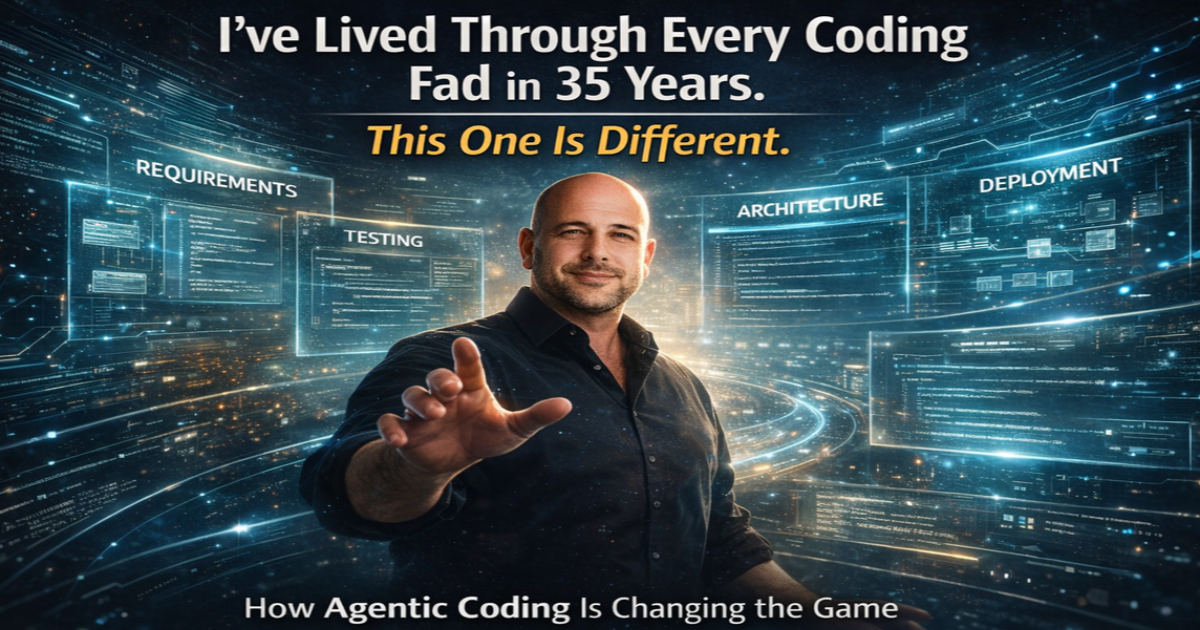
Here's an image that captures the essence of "The Evolution of Engineering" from traditional coding to agentic orchestration – a seasoned developer observing a complex, interconnected digital system with abstract glowing lines, symbolizing the shift from manual code writing to directing intelligent systems.
We are moving from being primarily syntax operators to becoming system orchestrators. From writing every line manually to directing intelligent systems through disciplined processes. The human role does not diminish. It becomes more strategic.
Agentic coding is not magic. It is not autonomous genius. It is a tool. But in the hands of someone who understands requirements, architecture, testing, and deployment, it is the most powerful tool I have ever used.
The journey is not about surrendering craftsmanship. It is about evolving it.
And having crossed that threshold, I have no desire to return to the ordinary world of writing everything alone.
Explore stories of breakthrough software, bold ideas, and the people behind tomorrow’s solutions.
![<subject>[interface] screenshot of collaboration interface (for a productivity tools business)</subject>](https://cdn.prod.website-files.com/68d162bfd50a4091704dc87d/699b87eb8c270575dc039266_1733426455876.png)
Discover how smart automation is reshaping farming, boosting yields, and empowering sustainable growth.

Dive into the journey of building a mobile app that modernizes a 140-year-old industry for today’s teams.

Explore how AI is moving beyond buzzwords to redefine mobile applications, delivering personalized experiences, enhancing health, boosting productivity, and democratizing technology for billions of users worldwide.

Follow the story of a bold product idea, from concept to launch, and the lessons learned along the way.